
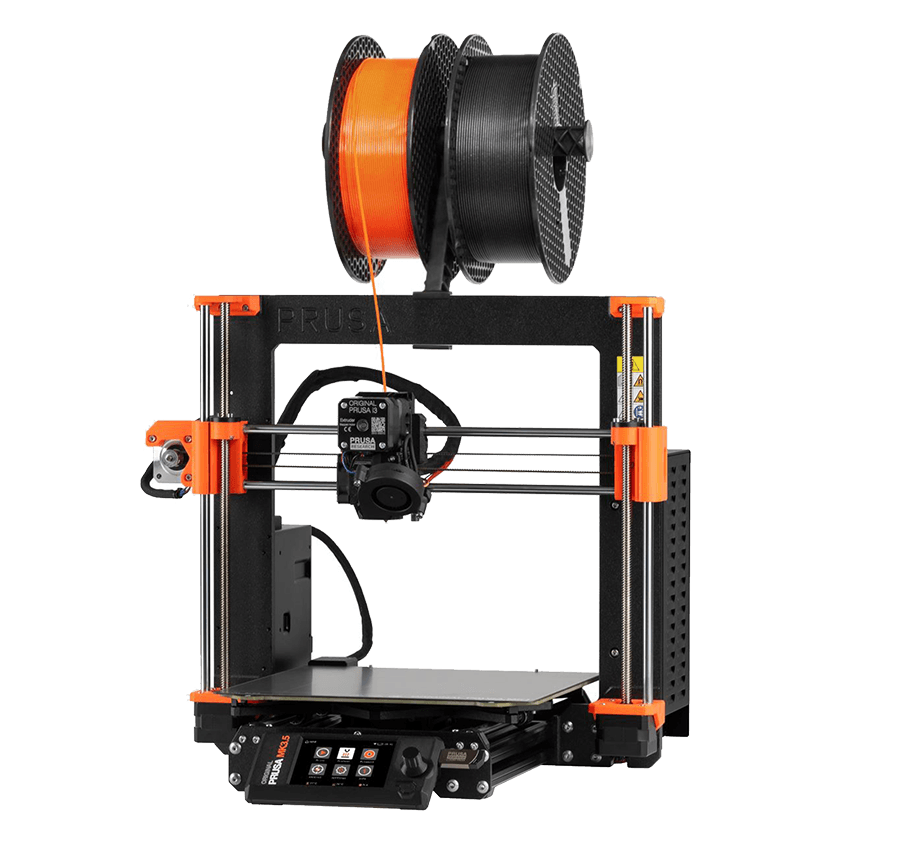
Prusa MK3.5
The Prusa MK3.5 is a proven workhorse in the 3D printing community. Fully open-source, highly customizable, and known for consistent, reliable prints. It's a great choice for learning the fundamentals of FDM printing because the slicer settings are well-documented and the community support is massive.
$5 / hr·$3 / hr for members
Try before you buy
Not sure if this is right for you? Come use ours. Day passes start at $15, or get unlimited access with a membership.
What you can make
- Learning 3D printing fundamentals
- Prototyping with different materials
- Detailed, high-quality single-color prints
- Functional parts (PETG, ASA)
- Experimenting with slicer settings
Specifications
- Build Volume
- 250 × 210 × 210 mm
- Layer Height
- 0.05 – 0.30 mm
- Nozzle
- 0.4 mm (brass, swappable)
- Bed
- Spring steel, heated
- Auto Leveling
- Yes (mesh bed leveling)
- Materials
- PLA, PETG, ASA, TPU, Nylon
- Connectivity
- USB, SD card, PrusaSlicer
- Open Source
- Yes (firmware, hardware, slicer)
Find models & resources
- Printables →
Prusa's community model library — tested profiles for the MK3.5.
- Thingiverse →
One of the largest libraries of free 3D printable models.
- MakerWorld →
Bambu Lab's model library. Most models work on any FDM printer.
- Patreon →
Models from artists as part of a subscriber perk.
- Etsy →
Wide range of models available for sale – most licenses restrict resale and redistribution.
Frequently Asked Questions
- What's the difference between the Prusa and the Bambu Lab?
- The Prusa MK3.5 is open-source, slower, and gives you more control over settings — great for learning. The Bambu Lab A1 is faster, supports multi-color, and is more plug-and-play. Both produce great results. Try both in our Advanced class.
- Can I use PrusaSlicer on the Bambu Lab too?
- Technically yes, but we recommend Bambu Studio for the A1 since it integrates with the AMS Lite. PrusaSlicer is the go-to for the Prusa MK3.5.
- Is the Prusa better for beginners or advanced users?
- It's great for both. Beginners benefit from the reliability and community documentation. Advanced users appreciate the open-source firmware and hardware customization options.